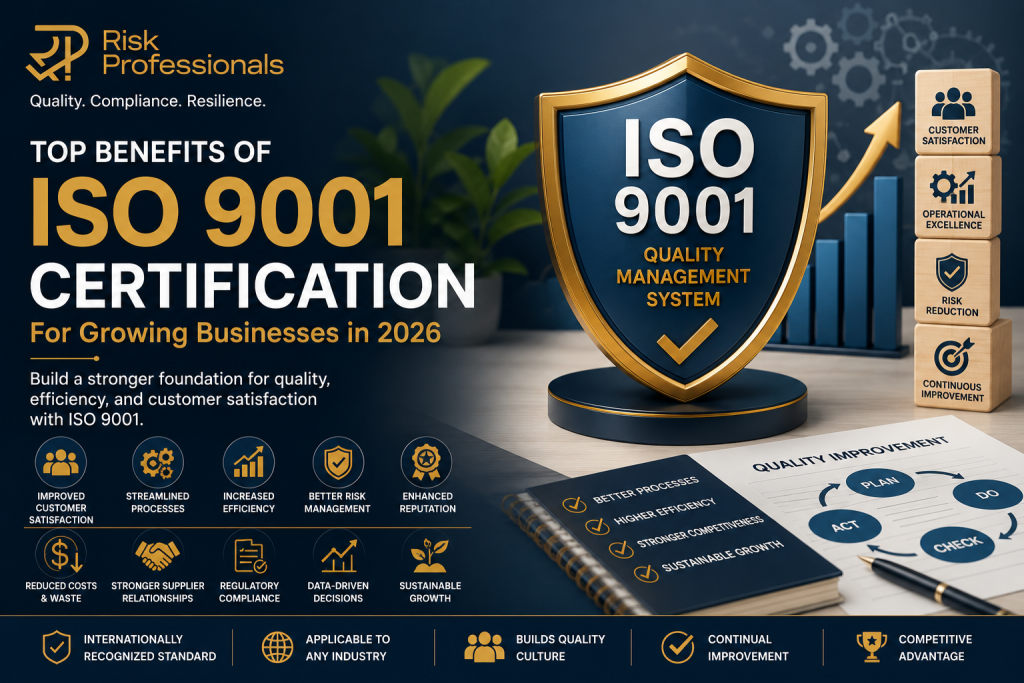
In today’s competitive business environment, quality is no longer just a differentiator, it’s an expectation. Customers, regulators, and business partners increasingly demand consistent products, reliable services, and well-managed business processes. As organizations expand into new markets and scale their operations, maintaining quality while managing growth becomes more challenging.
This is where ISO 9001 certification provides a significant advantage.
Recognized as the world’s leading Quality Management System (QMS) standard, ISO 9001 helps organizations improve operational efficiency, enhance customer satisfaction, reduce risks, and build a culture of continual improvement.
Whether you’re a startup, an SME, or an established enterprise, implementing ISO 9001 can strengthen your business foundation and prepare you for sustainable growth in 2026 and beyond.
What Is ISO 9001?
ISO 9001 is an internationally recognized standard for Quality Management Systems (QMS), published by the International Organization for Standardization (ISO).
The latest version, ISO 9001:2015, provides a framework for organizations to consistently deliver products and services that meet customer and regulatory requirements while continually improving business performance.
Unlike industry-specific certifications, ISO 9001 applies to organizations of every size and sector, including:
- Manufacturing
- Construction
- Healthcare
- Information Technology
- Education
- Professional Services
- Logistics
- Government
- Engineering
- Retail
- Financial Services
Instead of prescribing how a business should operate, ISO 9001 provides principles that encourage organizations to develop efficient, repeatable, and customer-focused processes.
Why ISO 9001 Matters in 2026
Business expectations continue to evolve rapidly.
Organizations today must manage:
- Rising customer expectations
- Global competition
- Supply chain disruptions
- Regulatory compliance
- Digital transformation
- Workforce challenges
- Sustainability initiatives
- AI-driven business processes
Companies with well-defined quality management systems adapt faster because their processes are documented, measurable, and continually improved.
Top Benefits of ISO 9001 Certification
Below are the key benefits that Certified ISO 9001companies can enjoy over their competitors.
1. Improved Customer Satisfaction
The primary objective of ISO 9001 is meeting customer requirements consistently.
Organizations implementing ISO 9001 focus on:
- Understanding customer expectations
- Delivering consistent quality
- Monitoring customer feedback
- Addressing complaints effectively
- Continually improving customer experience
Satisfied customers are more likely to become repeat customers and recommend your business to others.
2. Standardized Business Processes
As organizations grow, inconsistencies naturally emerge.
Different departments often develop different ways of completing similar tasks.
ISO 9001 helps standardize processes by establishing:
- Documented procedures
- Standard operating procedures (SOPs)
- Defined responsibilities
- Performance metrics
- Process controls
This creates consistency across the organization.
3. Increased Operational Efficiency
One of the biggest advantages of ISO 9001 is eliminating waste.
Organizations identify:
- Inefficient workflows
- Duplicate activities
- Process bottlenecks
- Communication gaps
- Non-value-added activities
The result is improved productivity and reduced operating costs.
4. Better Risk Management
ISO 9001 incorporates risk-based thinking into everyday business operations.
Organizations proactively identify:
- Process risks
- Supplier risks
- Operational risks
- Customer risks
- Compliance risks
Rather than reacting to problems, businesses prevent them before they occur.
5. Greater Employee Engagement
Employees perform better when responsibilities are clearly defined.
ISO 9001 promotes:
- Clear accountability
- Competency development
- Employee involvement
- Continuous learning
- Process ownership
This creates a stronger organizational culture focused on quality.
6. Stronger Supplier Relationships
Business performance depends heavily on suppliers.
ISO 9001 encourages organizations to evaluate suppliers based on:
- Performance
- Reliability
- Delivery timelines
- Product quality
- Compliance
Better supplier management reduces disruptions across the supply chain.
7. Competitive Advantage
Many government agencies and large corporations prefer or require suppliers to hold ISO 9001 certification.
Certification demonstrates that your organization has:
- Mature business processes
- Quality controls
- Management commitment
- Continuous improvement practices
This often improves success rates during tenders and procurement processes.
8. Improved Decision Making
ISO 9001 emphasizes evidence-based decision making.
Organizations monitor:
- Key Performance Indicators (KPIs)
- Customer satisfaction
- Internal audits
- Process performance
- Nonconformities
- Corrective actions
These insights help leaders make informed business decisions.
9. Easier Regulatory Compliance
Although ISO 9001 is not a regulatory standard, it helps organizations establish structured compliance processes.
Businesses become better prepared for:
- Industry regulations
- Customer audits
- Government inspections
- Internal governance requirements
10. Supports Sustainable Business Growth
Growing businesses often struggle to scale without sacrificing quality.
ISO 9001 creates repeatable systems that support expansion while maintaining consistent service delivery.
Organizations become better equipped to:
- Open new offices
- Expand internationally
- Hire new employees
- Launch new products
- Acquire new customers
Key Principles of ISO 9001
The ISO 9001 standard is built around several quality management principles:
- Customer Focus
- Leadership
- Engagement of People
- Process Approach
- Improvement
- Evidence-Based Decision Making
- Relationship Management
Together, these principles create a strong foundation for long-term organizational success.
The ISO 9001 Certification Process
Certification generally follows these steps:
- Initial Gap Analysis
- Define the Scope of the QMS
- Develop Quality Policies and Objectives
- Document Business Processes
- Conduct Risk Assessments
- Train Employees
- Implement the Quality Management System
- Perform Internal Audits
- Conduct Management Reviews
- Stage 1 Certification Audit
- Stage 2 Certification Audit
- Ongoing Surveillance Audits
Organizations working with experienced consultants often complete this process more efficiently while avoiding common implementation mistakes.
Common Challenges During ISO 9001 Implementation
Many businesses face obstacles such as:
- Lack of management commitment
- Poor documentation
- Undefined processes
- Employee resistance to change
- Limited internal resources
- Weak internal audits
- Inconsistent process monitoring
Working with experienced ISO consultants significantly reduces these risks.
ISO 9001 vs ISO 27001: What’s the Difference?
Although ISO 9001 and ISO 27001 share a similar management system structure, they serve different business objectives.
| Feature | ISO 9001 | ISO 27001 |
| Primary Focus | Quality Management | Information Security Management |
| Objective | Improve product and service quality | Protect information assets |
| Management System | Quality Management System (QMS) | Information Security Management System (ISMS) |
| Main Goal | Customer satisfaction and continual improvement | Confidentiality, Integrity, and Availability (CIA) of information |
| Typical Users | All industries | Organizations handling sensitive information |
| Risk Focus | Business process and quality risks | Cybersecurity and information security risks |
| Key Controls | Process management, quality objectives, customer feedback | Security controls, access management, incident response, cryptography |
| Common Benefits | Operational efficiency, improved quality, customer trust | Reduced cyber risk, regulatory compliance, stronger security posture |
How Risk Professionals Helps Organizations Achieve ISO 9001 Certification
Successfully implementing ISO 9001 requires more than creating documents—it requires building a practical Quality Management System that supports your business objectives.
At Risk Professionals (RiskProfs), we help organizations simplify the certification journey through a structured, risk-based approach tailored to their industry and operational needs.
Our ISO 9001 consulting services include:
ISO 9001 Gap Assessment
We evaluate your existing business processes against ISO 9001 requirements to identify compliance gaps and prioritize improvement opportunities.
QMS Design and Documentation
Our consultants assist with developing and customizing essential Quality Management System documentation, including:
- Quality Manual (if applicable)
- Quality Policy
- Quality Objectives
- Standard Operating Procedures (SOPs)
- Process Maps
- Risk Registers
- Corrective Action Procedures
- Internal Audit Programs
- Management Review Templates
Process Improvement
Rather than creating unnecessary paperwork, we focus on improving real business processes by identifying inefficiencies, reducing waste, and strengthening operational controls.
Internal Audits
Our experienced auditors conduct internal audits to identify nonconformities before the certification audit, ensuring your organization is fully prepared.
Employee Training
Successful ISO 9001 implementation depends on employee engagement. We provide practical awareness sessions and training to help teams understand their responsibilities within the Quality Management System.
Final Thoughts
As businesses navigate increasing competition, digital transformation, and evolving customer expectations in 2026, ISO 9001 certification provides a proven framework for improving quality, operational efficiency, and customer satisfaction. It helps organizations establish consistent processes, reduce waste, manage risks proactively, and build a culture of continual improvement.
Partnering with experienced consultants like Risk Professionals ensures that your Quality Management System is practical, scalable, and aligned with your business objectives. Whether you’re pursuing your first ISO certification or building an integrated management system with standards like ISO 27001, ISO 22301, or ISO/IEC 42001, the right guidance can help you achieve certification faster and realize lasting business value.
Frequently Asked Questions
How long does ISO 9001 certification take?
Depending on the size and complexity of the organization, certification typically takes between 3 and 9 months. Businesses with established processes may complete the certification faster with the support of experienced consultants.
Is ISO 9001 mandatory?
No. ISO 9001 is a voluntary certification. However, many customers, government agencies, and enterprise clients require suppliers to maintain ISO 9001 certification.
Which industries benefit from ISO 9001?
Almost every industry can benefit, including manufacturing, IT, healthcare, construction, education, logistics, engineering, retail, financial services, and professional consulting.
Does ISO 9001 improve profitability?
While certification itself does not guarantee higher profits, organizations often reduce costs through improved efficiency, fewer errors, better customer retention, and stronger operational performance.
Can ISO 9001 and ISO 27001 be implemented together?
Yes. Because both standards follow the Annex SL high-level structure, they can be integrated into a single management system, making implementation and ongoing maintenance more efficient.