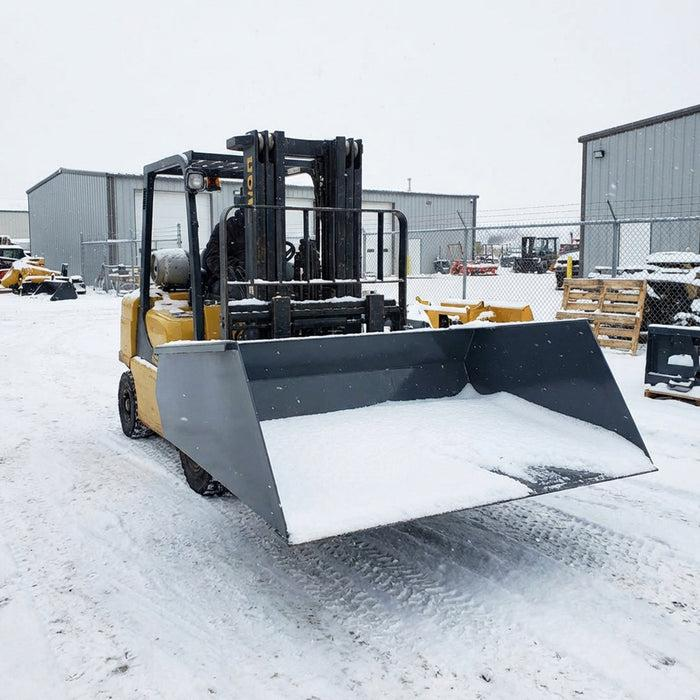

A warehouse yard fills with snow just as the loading docks get busiest, and the forklift is already there. A forklift snow bucket turns that truck into a snow mover, a salt carrier, and a debris hauler without a second machine. The risk is easy to miss: the number on the bucket is not the number on the truck.
Two Ratings, One Truck
The TMG-FSB64 is rated for a 4,000 lb load and weighs about 530 lb itself. That rating describes the bucket, not what the forklift can lift with it. Every forklift has a capacity plate, usually based on a 24 inch load center, and a bucket 55 inches deep puts its load well beyond that. The farther the load sits from the front wheels, the less the truck can safely lift, so the plate figure must be reduced before any heavy scooping.
Do the Volume Arithmetic
The inside dimensions are 64 by 55 by 24 inches, which works out to roughly 49 cubic feet. Fresh snow is light and a full bucket may weigh a few hundred pounds, but wet snow is much heavier. Rock salt is far denser, and dry sand denser still, at roughly 100 lb per cubic foot, so a full bucket of sand could exceed the bucket’s own rating. Fill it partway with dense materials and keep the weight within the derated capacity.
Mounting and Control
The bucket slides onto 36 inch pallet fork blades, using fork slots that measure 6 by 2-3/4 inches at 25 inch spacing, and a safety chain secures it to the carriage. A 114 inch pull cord lets the driver dump from the seat, and an automatic lock returns the bucket to upright afterward. A 90 degree dump angle empties it cleanly, which cuts down on climbing in and out of the cab in cold weather. The beveled front edge helps the bucket slide under packed snow and scrape pavement, and a forklift bucket this size can also carry salt, sand, or debris, so the same attachment works through the whole winter.
Loading Technique
Approach a pile with the bucket flat on the pavement and the mast tipped slightly back, drive in, and tilt back only once it is full. Overfilling spills material toward the driver and hides the load from view, so scoop in layers instead of heaping. Use the pull cord only when the truck is stopped, and carry the bucket just above the surface when traveling. After a heavy snowfall, clear a path from the dock outward in straight runs, which keeps the number of turns, and the stress on the steering, as low as possible.
Working Safely
Drive slowly with the bucket low, keep the load where the operator can see over it, and avoid turning on slopes. Keep other people clear of the dump zone, and never stand under a raised bucket. Compared with a forklift snow plow blade, a forklift snow bucket carries snow away instead of pushing it, which suits tight docks where there is nowhere to push it. Before the first storm, practice with the pull cord and the lock in an empty lot, so the routine is automatic when conditions are poor. TMG Industrial lists the TMG-FSB64 alongside forklift accessories such as the TMG-FLR13 forklift ramp.