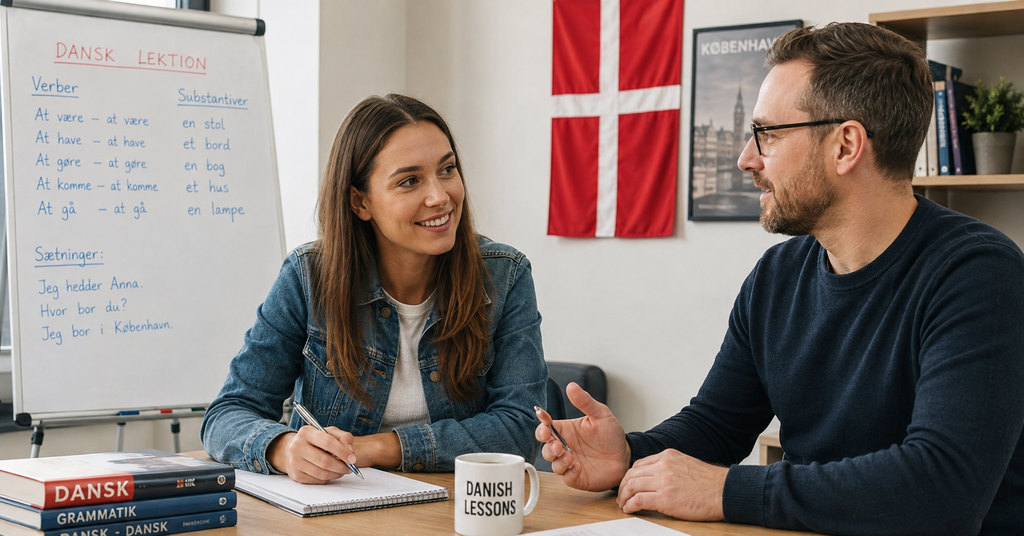
Whether moving for work or study, for family or a new lifestyle, there are exciting plans and possibilities coming Denmark’s way. However, accommodation and employment are only a part of it when migrating to a new country. People speaking the domestic language have a much better life in daily communication; it is much easier for them to communicate and interact in their workplace and within the community. While many Danes are able to engage in good English, it may be helpful for a foreigner to speak Danish so as to make a deeper connection with their community and be more confident in the professional environment. Learning Danish also forms part of many immigrants’ large-scale plans, for example, to become a citizen or embark on a career. The final exam P6 Danish (PD3) is a major success for the Danish student, which requires especially good preparation and practice.
Why Is Danish Important for Foreigners in Denmark?
Newcomers might think it is not necessary to learn Danish as a newcomer to Denmark; Danish people are generally very proficient in English. However, relying solely on English can be a challenge for some aspects of daily living.
Knowing Danish helps foreigners to communicate with neighbours, colleagues, public administration and local communities. It can also make social situations more comfortable and assist with encountering and establishing a relationship with Danish-speaking people.
Language proficiency may be beneficial for international professionals. When speaking in Danish on the job, at work or in local interactions, many people moving to Denmark from other countries, including Australia, might find productive use of the language at work. Moving to Denmark might also find workplace communication easier if it is done in Danish, even when the interactions are informal.
Danish Can Improve Workplace Integration
While many companies in the international world use English as their official language, Danish still has its merits. Being able to follow conversations, communicate with Danish-speaking colleagues and confidently participate in workplace activities is facilitated by an understanding of the local language.
Depending on your profession, being proficient in the Danish language may even be more significant for some regulated professions. For internationally trained physicians, for instance, certain language skills must be fulfilled to gain the necessary professional authorisation in Denmark.
What Is the PD3 Examination?
Prøve i Dansk 3, or PD3 for short, is a Danish language test for adults. Measures a number of major communication skills, such as reading, writing, listening, and speaking.
This examination requires more than the Norwegian person’s basic knowledge of conversational Danish; it is not a single-semester course in that language. They should have a good ability to read and write, communicate & interact to express thoughts and ideas clearly and creatively.
Some immigrants might also pursue PD3 as a necessary intermediate step towards the Danish language requirement linked to other goals, such as citizenship. Given this context, the candidates should have a structured and realistic approach towards preparation for the examination.
Why Is PD3 Difficult to Pass?
PD3 can be challenging as candidates must show competence in various language skills. A learner can understand the Danish used in complex listening extracts but make the Danish communicative writing aspect smoother by means of regular Danish conversations.
Develop All Four Language Skills
Successful preparation requires more than just vocabulary; it requires reading, writing, listening and speaking.
It is useful to enhance their understanding by reading articles and other authentic material in Danish. Learning Danish conversations, news, or even educational material can also help the learners to understand the natural way of speech and pronunciation.
The importance of writing practice is equal, as candidates must clearly organize their ideas and must employ suitable words and grammar. Finally, in speaking practice, the learner can develop in fluency, pronunciation and confidence.
Start Preparing Well in Advance
Waiting to prepare last minute can put undue strain. Learners should instead, rather than taking a shot at it, regularly develop their language study and start to gradually develop the skills of Danish.
Vocabulary building, grammar, reading, listening, writing, and frequent oral practice can be a realistic schedule. Candidates can develop this balanced approach and recognize the areas of weakness and work on them before the examination, over time.
How Private Danish Lessons Can Help
Self-study may or may not be a good thing, but many students find it helpful to have someone more knowledgeable who can pinpoint what is missing. This is especially important when setting yourself up for a challenging test like PD3.
If you are wondering how to pass PD3, personalised instruction can be an effective part of your preparation. Private Danish lessons provide one-on-one support, allowing the teacher to focus entirely on the student’s individual needs.
The material is the same as that for the larger group but the learner receives lessons that are tailored to their particular Danish ability, learning target, and problem areas.
Get Individual Feedback
Immediate feedback is one of the biggest things in favour of private lessons! The teacher can detect grammar errors, pronunciation issues, word knowledge, sentence structure, etc.
It will give students the opportunity to catch errors before they become ingrained. In addition, there may be various speaking, writing, reading and listening exercises which are tailored to the needs of the learner within the lessons.
Practise Danish With Greater Confidence
However, for students who have few opportunities to speak Danish, speaking can be one of the most difficult areas of learning.
Lessons on a 1-1 basis offer a relaxed setting for consistent speech training. They will have the opportunity to pose questions, practice the scenarios and get leads without the sense of pressure from a big classroom size.
Create a Practical PD3 Study Plan
Any preparation plan ought to be a blend of teacher-led and independent study. In order to consolidate the lessons the student is able to read in Danish, listen to Danish media, use new vocabulary and practise the Danish during daily activities.
Regularly updating on progress is also beneficial. A learner, for instance, may make a list of common errors in grammar or words which he or she does not know and use this as a reference list for any subsequent study time.
First and foremost, consistency of preparation is key. Frequent short practice sessions may be better than long sessions of studying followed by breaks.
Prepare for More Than the Examination
Learning Danish should not be done as a means to a specific grade. The language can be used in daily life in Denmark.
Faster workplace communication, social integration, and better coping with everyday situations are a number of other advantages that immigrants will gain with better Danish competencies. It can also help to achieve other aspects of a career for those who have other language needs.
Thus, during the PD3 preparation, it is an opportunity to practice linguistic skills in a specific direction towards a goal.
Take a Structured Approach to Danish Learning
Embarking on a trip to Denmark can be a fulfilling experience, and getting to know the Danish language will make it that much simpler. English is widely spoken; however, Danish can offer great advantages in business and social settings.
No chance should be taken to underestimate the challenge for learners preparing for PD3. Consistently prepare for the examination that will test and assess a variety of language skills. Your own personalised private lessons in Danish and regular practice, matched with independent study, can be more focused.
Foreigners can boost their ability in the Danish language, prepare themselves to pass the PD3 exam with the right support, and acquire communication skills, which are useful even after the exam.