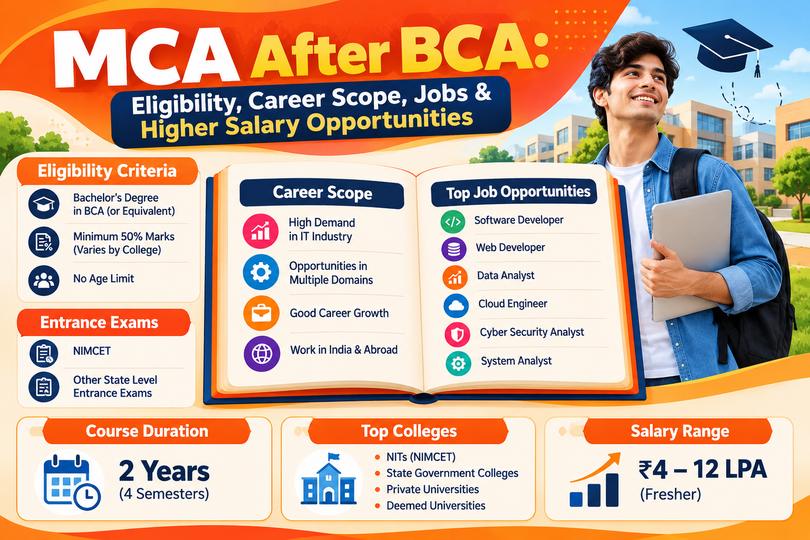

After a BCA degree, students have the option of entering the workforce or continuing their studies with a Master of Computer Applications. This will give them more technical skills. An MSc typically expands upon a student’s knowledge gained during a bachelor’s degree. They will learn about software engineering, databases, and advanced programming. This can lead to careers as a software developer, data engineer, and IT consultant. The benefits will depend upon the institution, what is covered within the course, and the hands-on experience you get. Throughout this blog, we will cover everything you need to know when considering doing an MCA after your BCA.
Why Pursuing an MCA After BCA Is the Ultimate Career Upgrade
An MCA course can help students develop their technical skills and be better set up for roles requiring higher knowledge of computing. Typically, it will last for 2 years and will mainly involve advanced programming. You may study cloud computing, cybersecurity, artificial intelligence, and data science depending on the university.
If you are interested in pursuing a role in software engineering, an MCA can provide you with further academic knowledge and better work opportunities. Consider what will be covered throughout the course, placement rates, and overall cost before opting for a course.
Eligibility Criteria for MCA Admission After BCA
Generally, a BCA course provides a relevant academic background for MCA admission, but universities have different requirements for minimum marks, mathematics, and entrance examinations. Make sure you meet the eligibility requirements of each institution before applying.
Minimum Percentage Requirements in Graduation
As per the AICTE Approval Process Handbook 2024-2027, an aspiring MCA candidate generally needs to have a bachelor’s degree of a minimum of three years’ duration with aggregate marks of 50%. This percentage is relaxed to 45% for candidates belonging to the specified reserved categories. Individual universities and routes of admission may have specific additional requirements.
The Mathematics Mandatory Clause: AICTE Guidelines and Entrance Exam Rules
Under the new 2024-27 Approval Process Handbook from AICTE, Mathematics for regular first-year MCA is no longer a necessity for admission, but rather a preferred subject. Students who are able to secure a bachelor’s degree from any stream are eligible, given they meet the required grades. A bridge course must be taken by students who do not have a background in Mathematics and is set by each individual university.
Entrance and admission requirements for MCA vary from one exam and university to another, and often can require additional conditions such as having done Mathematics at the Class 12 level or higher. Candidates must review the brochure for the test they intend to take as well as the institution’s admission rules to ensure that they are qualified before they apply.
Popular MCA Entrance Exams You Need to Clear
You may have to take an entrance exam to get into a competitive postgraduate computing program.
National-Level Exams: NIMCET and CUET PG
NIMCET is a national-level entrance test for admission to MCA programs at participating NITs and IIITs. Institutes participating in the 2026 admission cycle were NIT Tiruchirappalli, NIT Warangal, NIT Delhi, IIIT Bhopal, and IIIT Vadodara. Eligibility and selection are based on the official brochure and rank obtained.
CUET PG is also a national-level entrance exam for admission, but not all universities use CUET PG for MCA admissions. The candidates need to select the correct test paper and check the program-specific eligibility criteria on the website.
Top State-Level Engineering and IT Entrance Tests
The State Common Entrance Test Cell, Maharashtra, conducts the MAH-MCA-CET for admission to MCA in the participating institutes in the state. There might be different entrance exams and other admission routes offered by different states and universities.
Core Specialisations to Choose in Your MCA Programme
An MCA specialisation can help you zero in on a specific technical career path. Availability varies by university, so check the actual curriculum before enrolling.
| Specialisation | Key Learning Areas | Potential Career Roles |
| Artificial Intelligence and Data Science | Machine learning, statistics, data processing | Data analyst, junior ML engineer |
| Cloud Computing | Cloud infrastructure, deployment, distributed systems | Cloud support engineer, cloud engineer |
| Cybersecurity | Network security, vulnerability assessment, secure systems | Security analyst, security engineer |
| Software Development | Programming, algorithms, software architecture | Software developer, software engineer |
| Web and Mobile Applications | Web technologies, application development | Web developer, application developer |
Choose the right specialisation based on the skills you want to develop and the jobs you intend to pursue, not simply the popularity of a specialisation.
High-Paying Career Options and Job Roles After MCA
An MCA can prepare you to work in technical roles within IT services, product development, financial technology, and consultancy. You could work as:
- Software Developer
- Application Developer
- Database Administrator
- System Analyst
- Quality Assurance Engineer
- Cybersecurity Analyst
Some more specific roles like Machine Learning Engineer or Cloud Engineer may require extra practical experience. Create projects, learn relevant tools, and complete internships to demonstrate to employers that you have the skills required to do the job. An MCA won’t guarantee a specific role or pay grade.
Salary Growth: BCA vs. MCA Career Trajectory
Salary varies with skills, role, location, employer, and experience. Graduates with better coding skills, project experience, and problem-solving ability may be better placed for competitive opportunities, regardless of their qualification.
| Career Stage | Salary |
| BCA fresher | ₹2.3–2.5 LPA |
| MCA fresher | ₹3.3–4.2 LPA |
| Entry-level software developer | ₹3-5 LPA |
Top Recruiting Companies Hiring MCA Postgraduates
MCA graduates can get technical and consulting jobs in companies like TCS, Infosys, Wipro, Accenture, Cognizant, Capgemini, HCLTech, and IBM. Startups, fintech companies, product companies, and specialised cybersecurity companies also hire for relevant roles.
The recruitment process will depend on the role, technical assessments, communication skills, and the eligibility criteria of the employer. Look at job descriptions and placement records to see which companies recruit from your preferred institution.
Conclusion
If you have a BCA, an MCA can be a good investment if you want further technical education or want to get recruited after your post-graduation. But before applying, compare the eligibility criteria, maths requirements, entrance exams, specialisation fees, and placement outcomes. You want to pick a program that is going to teach you applicable technical skills and get you into the career you want to pursue.