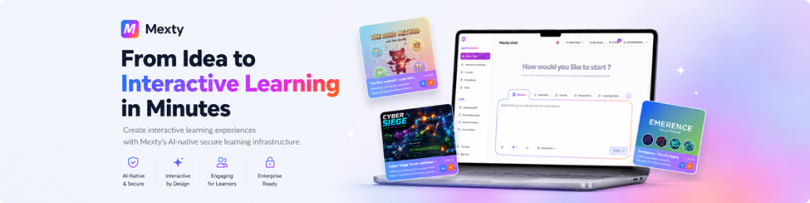

Creating engaging learning materials has always required more than presenting good information
In its recent article, How Teachers Can Create More Engaging Learning Materials, EducationPeer highlights several principles that matter: start with a clear learning goal, use meaningful visuals, connect lessons to real-world situations, design for accessibility, and most importantly, give students opportunities to participate rather than simply consume information.
That last point is becoming increasingly important.
A lesson may contain excellent explanations, attractive slides, videos, and illustrations, but students still need opportunities to think, decide, practise, make mistakes, receive feedback, and try again.
The challenge for teachers is that creating this level of interactivity traditionally requires much more time and, often, several different tools.
AI is beginning to change that.
Moving Beyond AI-Generated Content
The first generation of educational AI tools largely focused on content generation.
Teachers could ask AI to create a lesson plan, summarize a document, write questions, or produce a worksheet. These capabilities can save significant preparation time. EducationPeer also notes research showing that many teachers report time savings from AI across different work tasks.
But generating content is only the beginning.
The more interesting question is:
Can AI help teachers turn that content into an actual learning experience?
Instead of simply generating ten questions about a topic, imagine creating an activity where students must make a prediction, explore several possibilities, receive feedback, and reconsider their answer.
Instead of reading a case study, students could make decisions inside it and see the consequences.
Instead of presenting vocabulary on a slide, teachers could create matching activities, contextual exercises, games, short assessments, and repeated practice.
This is where an AI lesson creator for teachers can become more than a writing assistant.
From an Idea to an Interactive Activity
Mexty was designed around this shift.
Teachers can begin with an idea, existing teaching materials, or a source document and use AI to help transform it into interactive learning experiences.
For example, a teacher could take an existing PDF and use Mexty to Convert PDF to interactive course content containing questions, activities, scenarios, assessments, and multimedia.
Teachers can also create:
- interactive quizzes and formative assessments
- branching scenarios
- games and challenges
- simulations
- microlearning activities
- complete lessons and learning paths
The objective is not to replace the teacher’s instructional decisions. It is to remove some of the technical work required to turn those decisions into engaging experiences.
In that sense, Mexty is an Interactive Learning Platform designed to help educators create more active learning without having to become developers.
Interactivity Without Technical Complexity
Historically, sophisticated digital learning activities could require specialist authoring software, graphic design skills, or programming knowledge.
AI changes that relationship.
Teachers can increasingly describe the experience they want and then refine the result.
That makes it possible to create interactive courses without coding, while still allowing the teacher to review and edit the final learning experience.
This matters because interactivity should not simply mean clicking buttons.
As EducationPeer’s article explains, active learning works when students are asked to answer questions, solve problems, make predictions, and apply ideas.
Technology is valuable when it makes those pedagogical approaches easier to implement.
Speed Still Needs Trust
There is another important consideration.
AI can create material very quickly, but educational content must still be accurate, appropriate, and aligned with what teachers intend to teach.
Mexty therefore approaches AI as part of a broader secure educational AI platform, rather than treating generated content as automatically ready for students.
Teachers remain able to review and manually edit materials, work from trusted source content, and control what ultimately reaches learners.
That human oversight becomes increasingly important as AI-generated educational resources become easier to produce.
The goal should not be “one prompt and publish.”
It should be:
AI accelerates creation; educators remain responsible for the learning experience.
More Time for What Teachers Do Best
The biggest opportunity may therefore not be producing more material.
It may be giving teachers more time to think about the parts of learning that matter most:
What should students practise?
Where are they struggling?
What misconceptions should an activity reveal?
What feedback would help them improve?
How can the same concept be explored in several different ways?
AI can reduce the effort required to build those experiences.
But the teacher still provides the objective, context, judgment, and understanding of the learner.
That combination of human pedagogy supported by faster interactive creation may be one of the most useful ways AI can contribute to the classroom.
As EducationPeer rightly argues, engaging materials give students something meaningful to do.
The next step is making it dramatically easier for every teacher to create them.